Injection of Solid Active Ingredients
At sites with challenging geological conditions, conventional remediation methods are usually insufficient. Hydraulic stabilization methods, in particular, reach their limits in areas with low water permeability. In such cases, the injection of solid active agents offers a viable alternative—a technique that targets precisely those areas where other methods are ineffective.
The principle is simple: Solid active ingredients are injected directly into the subsoil and distributed there. This creates a reservoir of active ingredients in the subsoil to support the remediation processes. The method can be adapted to a wide variety of soil conditions and can reach even hard-to-access areas. In addition, biological and chemical active ingredients can be combined to achieve optimal remediation results.
TSE® (Targeted Solids Emplacement) High-Pressure Injection Technology
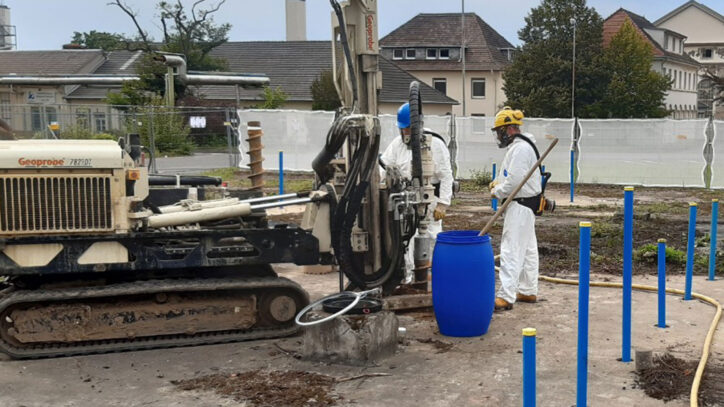
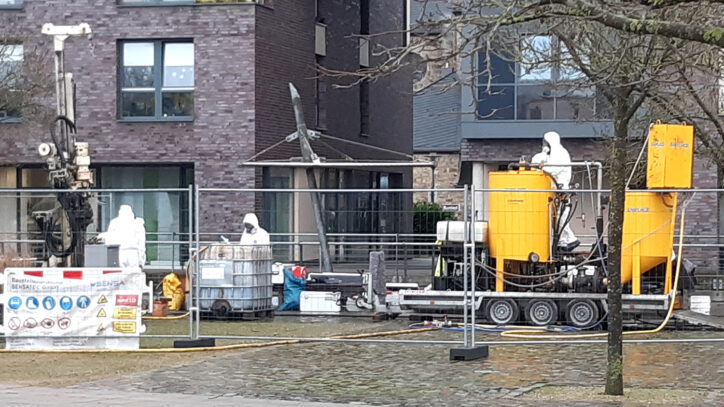
With our proprietary TSE® process, we offer a specialized remediation technique using drill-and-inject methods that allows us to place active agents in the subsurface even where soil conditions do not permit effective hydraulic distribution. For example, in bedrock, clay, loam, or marl formations, where there is virtually no water movement.
The process is based on the layer-by-layer high-pressure injection of biological or chemical active agents. These are introduced in solid form during the drilling process at intervals of approximately 30 to 40 cm, specifically targeting the contaminated zones. This allows the active agents to be effectively distributed radially throughout the contaminated area with a range of over 5 m. The highly impermeable “contaminant sources” are thus transformed into “remediation sources,” because after treatment, the active agents stored there are released into the groundwater in place of the contaminants.
References