Groundwater Circulation
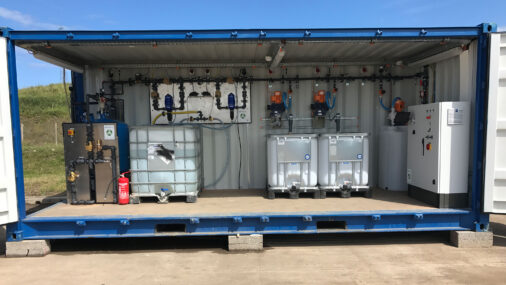
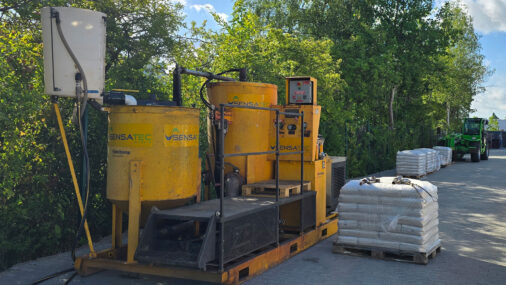
Circulation cells are based on the principle of selectively extracting groundwater, adding active agents to it, and reinjecting it into the subsurface. This creates a controlled flow cycle that enables the targeted transport and uniform distribution of biological and chemical active agents. Groundwater circulation measures are frequently used in the aerobic and anaerobic biological remediation of groundwater contamination.
Even at heavily built-up sites and actively used industrial areas—where large portions of the site are inaccessible by drilling—long distances within the aquifer requiring remediation can be bridged using actively managed circulation cells. We offer both the fluid dynamics calculation models and the technical implementation of such methods, which ensure success.
Vertical and Horizontal Circulation Cells
Vertical systems typically use conventional wells (injection/extraction), while horizontal systems are used over longer filter lengths, particularly in shallow or stratified aquifers.
When applied professionally, vertical and horizontal circulation cells are an excellent tool for the efficient distribution of active agents, even over greater distances between injection and extraction wells.
Thanks to our comprehensive technical expertise, we can specifically design and technically implement circulation cells to carry out biological and chemical remediation in the subsurface, even at heavily developed and utilized sites.
Pump-and-Treat Systems
The pump-and-treat method is a proven process for remediating contaminated groundwater. In this process, contaminated groundwater is extracted at designated pumping wells, treated at the surface, and then either reinjected into the subsurface or properly disposed of. By precisely controlling groundwater flow, the spread of contaminants can be specifically managed and reduced. Therefore, this method is particularly well-suited for preventing groundwater contamination from extending beyond the boundaries of the respective property.
This method is particularly well-suited for remediating localized or widespread contamination and can be flexibly adapted to the specific hydrogeological conditions. Combined use with other remediation techniques is generally possible and often highly advisable, as pump-and-treat methods rarely contribute to the actual elimination of groundwater contamination, since usually only a fraction of the contaminants is actually dissolved in the water. This typically results in these containment systems operating for years—and in some cases, even decades—without the source of contamination itself being eliminated. Nevertheless, containment-only methods designed to prevent the outflow of contaminants are absolutely justified.
We therefore offer the pump-and-treat method in combination with complementary in-situ remediation measures, including biological or chemical methods.