In-situ Chemical Remediation Methods
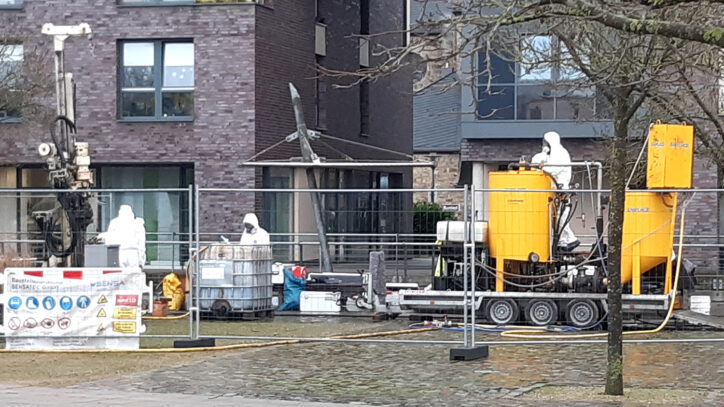
The use of in-situ chemical remediation methods represents an attractive option for the rapid remediation of soil or groundwater contamination. To this end, highly effective chemicals—such as oxidizing agents or reducing agents—are typically injected into the subsurface to chemically destroy the respective contaminants at their source.
The effectiveness of these minimally invasive methods depends on close contact between the active agent and the contaminant, as well as on tailoring the use of the active agent to the chemical conditions at the site.
Sensatec offers comprehensive expertise and many years of practical experience with a wide range of oxidizing agents commonly used in in-situ remediation to break down contaminants. These range from peroxide-based active ingredients to permanganates, persulfates, and percarbonates.
Based on a detailed site analysis through feasibility studies, we select the oxidizing agent with the best prospects for success from our broad product range and develop a customized strategy that optimally combines both technical efficiency and economic objectives.
In-situ Chemical Oxidation (ISCO)
In-situ chemical oxidation (ISCO) typically involves the use of strong oxidizing agents to oxidize and thereby destroy contaminants in the subsurface through a wet chemical process. The advantages of this process lie in its relatively fast reaction rate and low susceptibility to disruptions.
We select the oxidizing agent that is best suited to the specific remediation project, the mix of contaminants, and the geochemical conditions at the site.
We can introduce the oxidizing agents in the form of liquid reagents, such as Fenton’s reagent or permanganate solutions. In addition, we can use solid injection to create an oxidative active ingredient reservoir (e.g., with persulfate mixtures or Provect-OX) using the TSE injection technique. In some cases, oxidizing agents can also be used in gaseous form (ozone) or as an aerosol to treat the unsaturated soil zone.
In-situ Chemical Reduction (ISCR)
In-situ chemical reduction (ISCR) is based on the addition of reducing agents that either break down pollutants through chemical reduction (e.g., chlorinated solvents) or convert them into less hazardous substances, as is the case with chromate reduction, for example.
We have extensive practical experience in this area, both in the application of, for example, reductive nano- and micro-iron products and in their practical use.
References