

- Determining the Amount of Active Ingredient to Use
- Drilling Technology
- High-pressure TSE injections of the immobilization agent (brominated activated carbon) to a depth of 9 meters
- Construction of Monitoring Stations
Toxic Mercury and Highly Volatile Methylmercury in Soil: In-Situ Immobilization at a Former Explosives Site
Mercury in the groundwater—at concentrations of up to 650 µg/l. What had lain dormant underground for years on the site of a former explosives manufacturing facility posed a serious threat. A pump-and-treat system secured the site but did not provide a permanent solution to the problem. The goal was to find a method that would not only retain the mercury but also permanently bind it.
Client
Engineering Firm
Area
Approx. 500 m²
Service period
08/2021 – 12/2021
Contract value
250,000 €
Active agents
16,000 liters of MercLok
Contaminants
Elemental mercury, Methylmercury
Questions about the project
Key Services
Customer Benefits
- Permanent Elimination of Mobile Mercury
- Decommissioning of the pump-and-treat facility due to a more cost-effective mitigation measure
The Challenge: Mercury in All Its Forms
Mercury occurs in various forms in contaminated soil. At this site, several forms of the contaminant were present—elemental mercury, ionic mercury, and the particularly toxic methylmercury. Each form behaves differently in the subsurface and spreads differently. The remediation requires a method that addresses all variants simultaneously.
Added to this was the spatial dimension: The contamination extended over an area of 500 m² —from the unsaturated zone down to a depth of nine meters. A conventional pump-and-treat system could not permanently manage this contaminant load. A more sustainable and cost-effective solution was needed.
The Solution: Brominated activated carbon as a reactive barrier in the subsoil
Brominated activated carbon was used as a reactive solid to permanently immobilize the mercury compounds. The principle: The active ingredient chemically binds mercury in a permanent, covalent bond, thereby permanently removing it from the pollutant cycle—without additional energy input and without the need for continuous plant operation.
The technical implementation was carried out using TSE high-pressure injection, a method that precisely injects large quantities of active ingredients into the subsoil over a wide area—to depths of about nine meters.
MercLok in Action: 16,000 Liters Against an Invisible Danger
MercLok was used as the active agent—a suspension based on brominated activated carbon that was specifically developed to immobilize mercury compounds. A total of 16,000 liters of MercLok was applied at two different depths in the form of a Permeable Reactive Barrier (PRB):
- Unsaturated zone: 1–3 m below ground level
- Saturated zone: 6–9 m below ground level
This ensured that all relevant forms of contaminants—elemental, ionic, and methylated—were accounted for. Following the treatment, its effectiveness was verified and documented in a 300-day monitoring program.
Results: Mercury levels below the detection limit
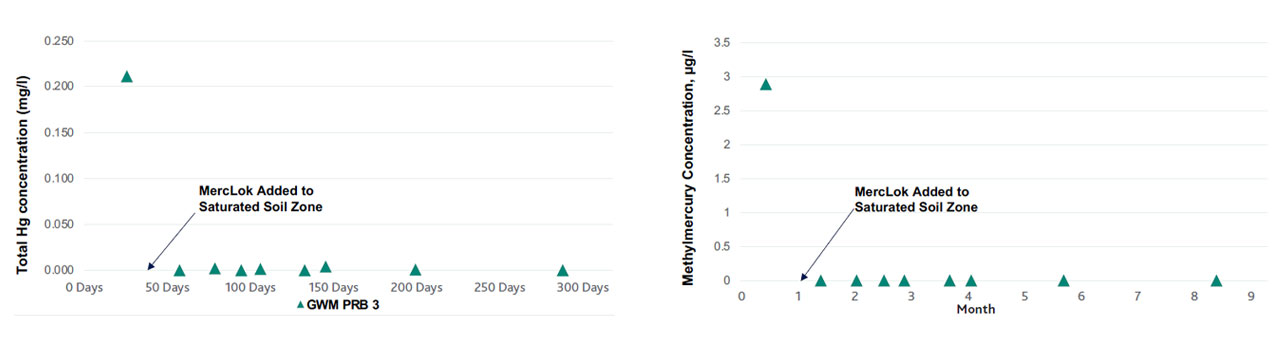
Following the injection and effective distribution of the immobilizing agent “MercLok,” the accompanying groundwater monitoring immediatelyrevealed a sharp reduction in mercury concentrations in the groundwater, bringing them close to the limit of detection. Mercury concentrations did not increase to detectable levels during the observation period of nearly 12 months. This demonstrated the long-term effectiveness of the remediation measure.