
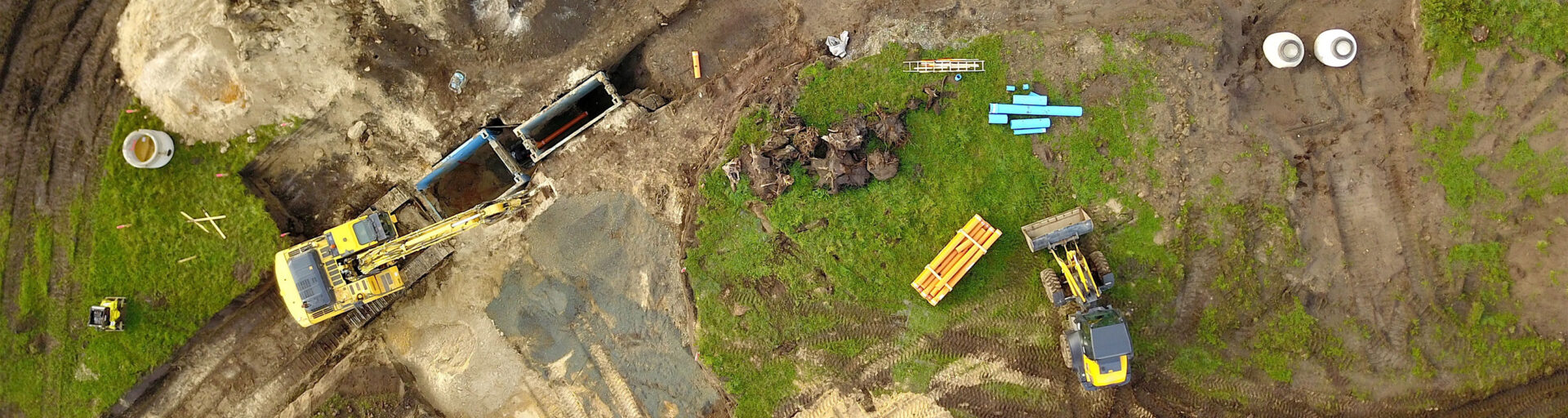
When remediating contaminated soil and aquifers, the decision quickly comes down to two fundamentally different approaches: excavating and removing the contaminated material (ex-situ) or treating it directly on-site (in-situ). At first glance, soil replacement seems simple and quick. Upon closer inspection, however, it becomes clear that this method is often associated with significant drawbacks that in-situ methods elegantly circumvent.
What is the rationale behind both approaches?
In ex-situ remediation, contaminated material is excavated and either treated in mobile facilities or transported away for disposal—for example, through soil washing, thermal desorption, or landfilling. In in-situ remediation, however, the soil remains in place. Contaminants are degraded, bound, or leached out directly in the subsurface through chemical, biological, or physical processes.
At a Glance:
| Ex situ (excavation) | In situ (on-site treatment) | |
|---|---|---|
| Land Use & Transportation | high | N/A |
| Carbon Footprint | burdensome | significantly lower |
| Operational Limits Based on Depth and Development | technically/economically limited | Also possible for damage that is low-lying or obscured by other structures |
| Use of the Site During Remediation | mostly restricted or construction halted | usually possible during operation |
The Weaknesses of Ex-Situ Remediation
As straightforward as excavation may seem on paper, it is often problematic in practice: Large-scale earthmoving involves massive disruption to the soil and land, high volumes of material to be transported, significant CO₂ emissions, and substantial costs for excavation, transportation, and disposal. Often, the problem isn’t actually solved, but merely shifted —from one’s own property to a landfill or an external treatment facility.
Even more serious: When contamination lies deep underground, excavation simply reaches its technical and economic limits. Contamination at a depth of 20 meters or beneath existing buildings can hardly be reached cost-effectively with an excavator. In such cases, the only option is often long-term containment using pump-and-treat systems. This carries the risk that it will become a so-called “permanent solution,” incurring operating costs for decades without actually remedying the underlying damage.
Furthermore, excavation typically forces a halt to construction or the shutdown of the affected area. For sites that are to continue to be used, leased, or developed in the short term, this is a significant economic disadvantage. Valuable time and opportunities for use are lost simply to move soil that could essentially be treated right where it is.
Why In-Situ Methods Are the More Compelling Alternative
In-situ technologies address precisely these weaknesses. Since the soil does not need to be moved, there is no land use, no transportation costs, and a significant reduction in CO₂ emissions. Particularly in cases of damage at great depths or beneath buildings —where excavation is practically impossible—in-situ treatment often remains the only realistic and, at the same time, most cost-effective solution.
Another key advantage: In-situ methods can be carried out without interrupting operations. Production facilities, commercial properties, or inner-city lots do not need to be shut down during the process. This is an advantage that the ex-situ method can practically never offer.
How Sensatec Puts These Advantages to Use in Practice
Since its founding in 2005, Sensatec has consistently specialized in innovative in-situ remediation methods and today employs over 60 experts at several locations in Germany. Its portfolio ranges from biological and chemical in-situ methods to thermal and physical remediation methods. From the From drilling technology toin-situ sensor technology developed in-house, all the way to plant control and process monitoring, Sensatec offers a full range of services entirely in-house.
A case study from Stuttgart-Feuerbach illustrates just how much more effective in-situ technology can be than traditional excavation. Despite extensive prior excavation, there remained a significant level of chromium(VI) contamination in the groundwater—which was being contained by a pump-and-treat system that threatened to become a permanent “long-term solution.” It was only a favorable window of opportunity prior to the urban development of the site that enabled Sensatec to implement an innovative in-situ process using surfactant-assisted extraction, which not only addressed the primary contaminant but also reduced associated VOC contamination in the groundwater. So the excavation alone had not solved the problem—it was the targeted in-situ treatment that brought about the breakthrough.
The difference is evident even in cases of complex chlorinated hydrocarbon contamination. At a former dry cleaning facility with groundwater contamination levels exceeding 100 mg/l, a direct comparison of alternatives showed that in-situ chemical oxidation with sodium permanganate, combined with hydraulic downstream protection, was a clearly superior solution to soil replacement. Due to the widespread distribution of the oxidizing agent in the subsurface, the remediation targets were demonstrably and permanently achieved, as confirmed by post-remediation monitoring.
In addition, Sensatec uses actively controlled circulation cells for biodegradable pollutants such as VOCs. Through continuously operated circulation systems, an organic substrate is distributed over a large area to accelerate natural microbial degradation in a targeted and sustainable manner, with direct contact between the substrate, microorganisms, and the contaminant being the key prerequisite for the success of the remediation.
Conclusion
At first glance, soil replacement may seem like a quick and tangible solution. In practice, however, it has been shown time and again that this method reaches its limits when dealing with deep-seated, extensive, or operationally sensitive damage. Furthermore, soil replacement incurs high follow-up costs, and problems are often merely shifted rather than resolved. In-situ technologies, such as those used by Sensatec, offer a more sustainable, cost-effective, and practical alternative —with the key advantage that the site remains usable during remediation.