

PFAS are considered“forever chemicals”—once they enter the environment, they practically never break down. What many people don’t know is that PFAS don’t just enter the soil and groundwater through a single, obvious route, but through a wide range of different sources that are often far apart.
If you’d like to learn more about the chemistry and origin of this class of substances, you can find the basics in our article“What Are PFAS?”
The question here is: What are the main causes of PFAS contamination in the soil?
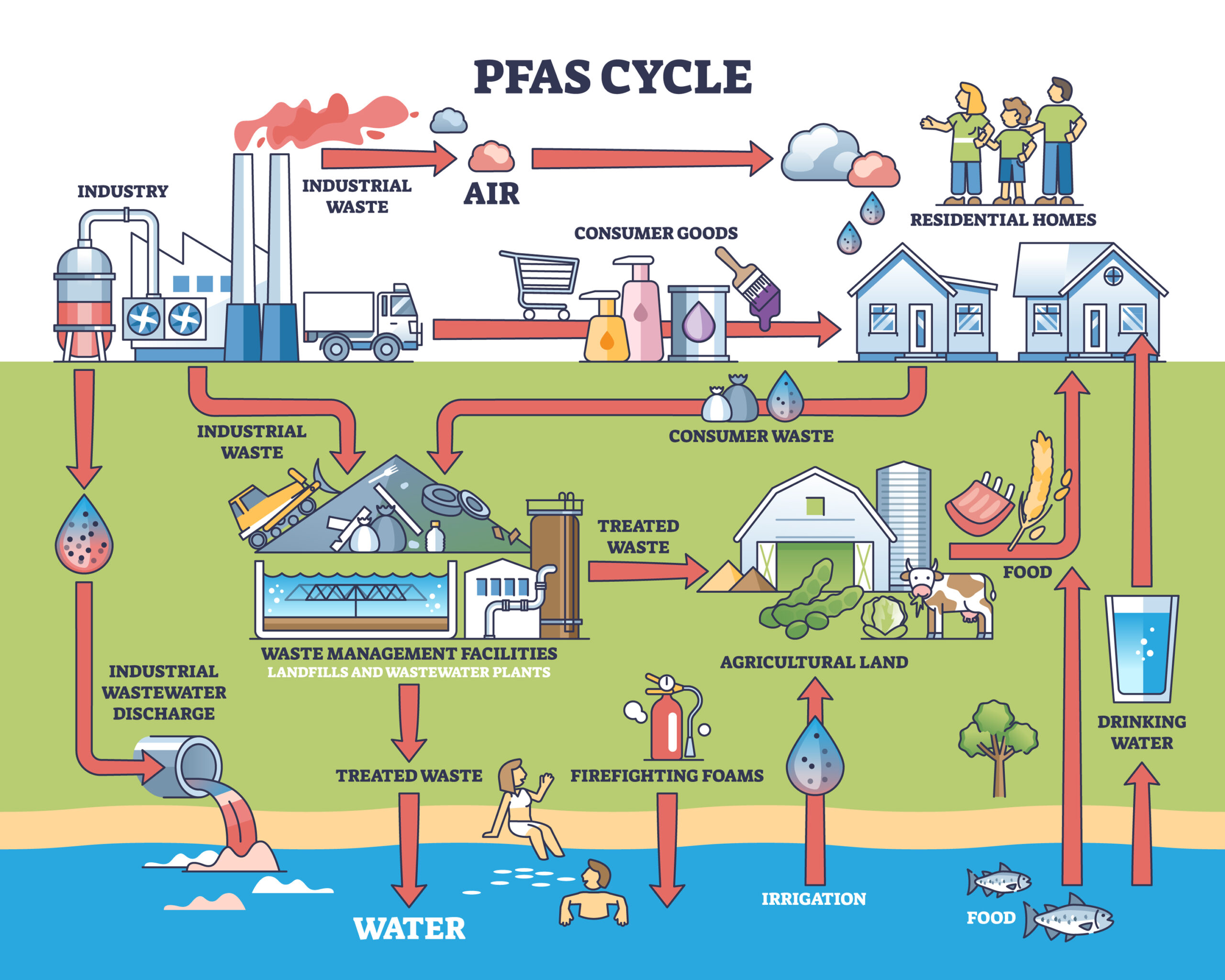
Firefighting operations
For decades, firefighting foams containing PFAS were used in fire department drills, industrial fires, and stationary fire suppression systems.
The pathway of entry into groundwater is often unspectacular: Automatic fire suppression systems, for example, can be triggered unintentionally and cover entire company premises with firefighting foam, which seeps into the ground with the next rainfall.
Even in the case of acute fires, such as those on highways, this can become particularly critical in drinking water protection areas. Old exploratory boreholes, traditionally backfilled with crushed sand, gravel, or crushed stone, provide an additional, often overlooked route of entry. These act as a direct channel for pollutants into the groundwater.
Under the new EU Regulation 2025/1988, the use of firefighting foams containing PFAS is now being phased out. Anyone still using these foams today can expect to find existing soil contamination at previous sites where they were used.
Airports
At airports, two sources of PFAS converge: PFAS-containing components in aircraft technology and the repeated use of firefighting foam during drills and emergencies. Since airports have been in operation for decades and combine large areas of both sealed and unsealed surfaces, they are among the sites with particularly complex PFAS contamination patterns.
Paper sludge
In paper production, PFAS have long been used as coating agents, for example to make packaging grease- and water-repellent. The sludge generated in this process was disposed of for years in fields or landfills —often without knowledge of its PFAS contamination—thus becoming a source of contamination for soil and groundwater.
Electroplating
In the metalworking industry, PFAS are used as wetting agents in electroplating baths. They reduce surface tension and prevent toxic vapors from rising. However, this comes with the side effect that PFAS can enter the soil via wastewater and contaminated sites.
Landfills and Old Deposits
Where materials containing PFAS have been landfilled, rainwater seeps through the waste mass and carries the substances into the leachate. Older landfills, in particular—those constructed before the introduction of modern lining standards—are frequently affected by this.
Textile Processing
As a water-repellent treatment, PFAS make textiles water- and stain-resistant—from outdoor clothing to technical fabrics. Textile finishing facilities are therefore among the classic areas of concern when it comes to historical PFAS contamination.
Agricultural Land
Even farmland that appears unremarkable at first glance can be affected: If PFAS-contaminated compost or sewage sludge is applied to improve soil quality, these substances enter agricultural soil directly—and potentially enter the food chain.
Atmospheric deposition
Not every source of contamination has a local origin right on site. PFAS can also be transported through the air —for example, from emissions in the fluorochemical industry—and can accumulate in soil over large areas and at great distances, far from the actual source.
Why This Is Relevant for Site Operators
All of these pathways have one thing in common: Contamination accumulates underground over the years and can seep into the groundwater unnoticed—until an investigation, a property sale, or a regulatory requirement brings the contamination to light.
Those who are aware of the potential sources of historical contamination can have targeted testing conducted early on—rather than being caught off guard by the findings.
The good news: There are solutions
As a remediation company, we assist you in investigating and remediating PFAS-contaminated sites—using in-situ methods that remove PFAS directly from the soil and groundwater on-site, without the need for soil replacement.