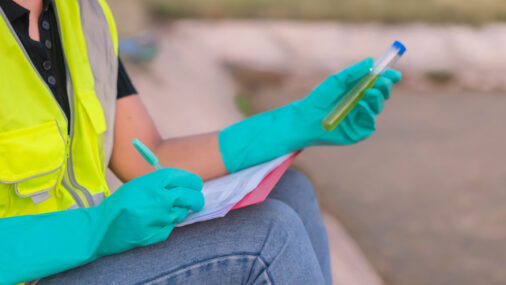
Cultivation of Specific Microorganisms
For the biological degradation of pollutants in soil and groundwater, we use specially cultivated aerobic and anaerobic microorganisms tailored to each specific application. The microorganisms that occur naturally in the soil or in (ground)water are adapted to the project-specific requirements and cultivated.
Thanks to our more than 20 years of experience, we have access to numerous high-performance microorganism cultures in our microbiology laboratory in Cologne. We can cultivate these on a large scale and use them for in-situ remediation measures (bioaugmentation).
Cultivation of Aerobic Pollutant-Degrading Microorganisms
We use our SENSABAC mixed cultures to break down various organic pollutants, such as gasoline, diesel, petroleum products, hydraulic oil, and PAHs. These are aerobic pollutant-degrading microorganisms that we cultivate ourselves in our laboratory at our Cologne branch.
Microbial Isolation
If molecular biological analyses identify microorganisms with the potential to degrade pollutants that are not yet available for cultivation here, they are obtained through microbial isolation at the Cologne laboratory.
In this process, individual microorganisms (e.g., bacteria or fungi) are isolated from a mixed sample and cultured in pure culture.
How do aerobic microorganisms help break down pollutants?
Aerobic pollutant-degrading microorganisms are“natural cleaners”that efficiently break down pollutants in the presence of oxygen and help reduce the burden on the environment.
Since 1993, aerobic microorganism cultures have been produced on a pilot scale for use in remediation projects, as they offer clear advantages:
- Effective at breaking down organic pollutants.
- Less formation of toxic intermediate products compared to anaerobic processes.
- Widely used in bioremediation (e.g., remediation of contaminated soil and wastewater).
We offer a comprehensive range of services related to bacterial cultures:
- Production Tailored to Needs: The right bacterial cultures for every application.
- Regular Quality Monitoring
- Delivery, application, and installation in quantities ranging from 20 liters to several cubic meters, depending on your needs.
- Safety classification according to BioStoffV: Protection Level 1, Risk Group 1
Our extensive product range includes the following crops:
- SENSABAC DK – Mixed Cultures for the Degradation of Gasoline and Diesel
- SENSABAC KW – Mixed Cultures for the Degradation of Petroleum Hydrocarbons
- SENSABAC Panolin – Mixed cultures for the degradation of hydraulic oils and hydraulic fluids
- SENSABAC PAK – Mixed cultures for the degradation of polycyclic aromatic hydrocarbons
- SENSABAC Biomineralizer – Mixed cultures for stabilizing soils, dikes, or spoil heaps, as well as for encapsulating contaminants
In addition, we enable the targeted cultivation of individual strains for specific applications.
If you have any questions, please feel free to contact Jessica Beyert:
For sites where lightly chlorinated hydrocarbons ( LCHCs ) have not been degraded to date, or have been degraded only very slowly, we use our SENSABAC-DHC microorganisms, which we cultivate specifically for this purpose in our laboratory at the Kiel branch. These microorganisms include the species Dehalococcoides mccartyi and can rapidly and effectively degrade SCCs under anaerobic conditions.
Cultivation of Anaerobic Pollutant-Degrading Microorganisms
The microorganism species Dehalococcoides mccartyi is a specialized bacterial species that uses chlorinated compounds—including VOCs—as an energy source. In the process, it gradually removes chlorine atoms from the molecules (reductive dechlorination).
Without the use of these microbial cultures, the degradation of volatile organic compounds (VOCs) is often incomplete, resulting in problematic intermediate compounds such as vinyl chloride and cis-dichloroethene. For this reason, SENSABAC DHC is specifically used in the remediation of LCKW in groundwater (bioaugmentation).
We are the only manufacturer in Germany of these high-performance microorganism cultures containing Dehalococcoides(SENSABAC-DHC) for the anaerobic degradation of chloroethene (chlorinated hydrocarbons).
We support our customers with a comprehensive package of services
- Analysis of the initial biogeochemical conditions with regard to dechlorination processes at the site
- Preparation of a suitable culture medium and propagation of a biodegradative culture in sufficient quantity
- Quality control of the enrichment process through detection of the degradation-related DNA segments tceA, vcrA, and bvcA
- Bioaugmentation / Transport of the bioaugmentation culture
- Provision of all materials required for anaerobic inoculation on site
- Molecular biological monitoring using qPCR to determine whether degradation-active genes are present in groundwater following bioaugmentation
To ensure the greatest possible success during a field remediation, a preparation period of approximately 8 weeks is required, as well as the following site-specific conditions:
- The patterns of pollutants and any degradation processes that may occur are known
- Anaerobic conditions already exist at the site (O₂ <0.2 mg/L) or can be achieved through biostimulation
- Presence of a groundwater monitoring well (at least 1″) for bioaugmentation
Since the microorganism cultures are prepared specifically for each location, a minimum order of 50 liters of SENSABAC-DHC is required.
If you have any questions, please feel free to contact Anja Wilken: